
Araluen’s rich history is not immediately evident as you look around the picturesque Araluen Valley. The Valley is now home to about 210 people, with primarily a quiet agricultural aspect and only a few unnatural mounds of earth pointing to stories of the past.
Araluen Valley in the second half of the 1800s was the site of the richest alluvial gold deposits in NSW and home to thousands of miners and their families. Many of whom are at rest in the two Araluen Cemeteries, with their resting place often marked with wooden crosses. These wooden memorials have not survived the ravages of time, floods, fire, and white ants. The Araluen History Group obtained funding through the Black Summer Bushfires Recovery Grant in 2021, with an area of focus to re discover, and remember those who lived, died and were buried in Araluen.
Who is at rest in the Araluen Cemeteries?
Burial records were inconsistently kept, and sometimes lost, and online databases held known inaccuracies, so the Araluen History Group began researching. Combining family historians, local, national and online databases and through accessing TROVE, we have been able to locate a large number of articles about deaths, burials, obituaries and family notices, which helped to identify those at rest in Araluen.
The project has not only determined the final resting place, but in many occasions has provided insights into the lives of those people who made Araluen their home. The outcomes of this research can be accessed at Araluen Cemeteries.
Roman Catholic
The Roman Catholic Cemetery in Burketown or Araluen West, was blessed by Archbishop Polding in July 1869.
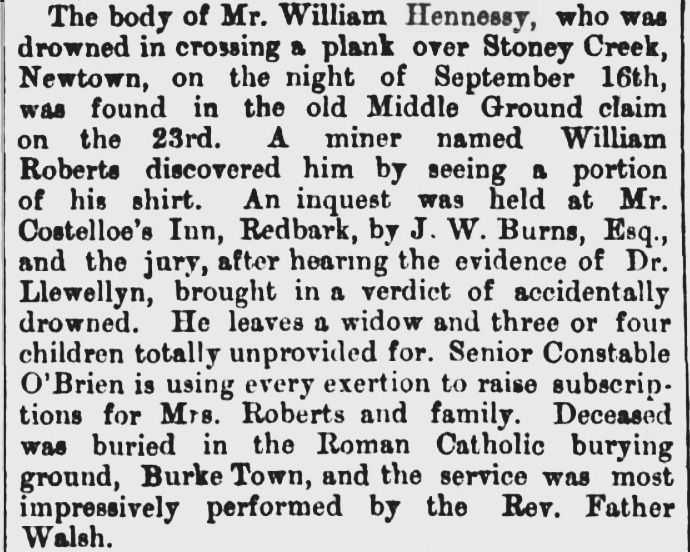
In October 1879 the Freeman’s Journal reported on the accidental drowning of William Hennessy, describing date and location of the fatal accident as well as the impressively performed graveside service, held at the Roman Catholic Cemetery, Burketown Araluen.
Upper Araluen /Appletree Flat/– Church of England
A Cemetery, now known as the Church of England cemetery, was gazetted on 3 August 1863 as a General Cemetery. Two acres were donated at Apple Tree Flat, to become the resting place for Anglican, Presbyterians, Methodists and Wesleyans.
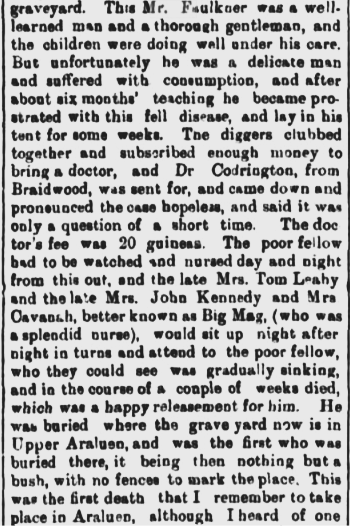
The first known burial in the Araluen General Cemetery was for Mr Charles Faulkner who died 16 December 1856. This was found in an article titled ‘The Braidwood gold fields in the 50’s and 60’s’, published in the Braidwood Dispatch and Mining Journal in October 1907.
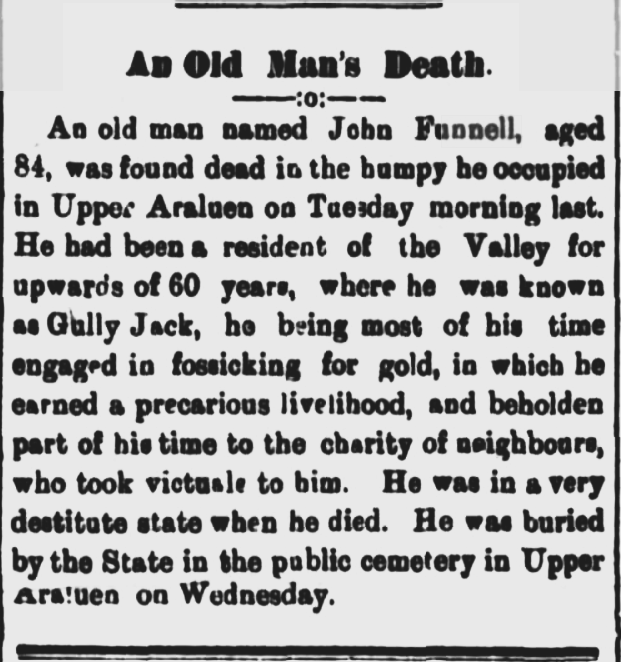
In April 1913 an article was published in the Braidwood Dispatch with the title ‘An Old Man’s Death’. The article described John’s nickname of Gully Jack, that he was found in his humpy, as well the community support for this long-term resident of the Araluen Valley, who was ‘beholden part of his time to the charity of neighbours’. A wonderful insight into the way of living for a gold fossicker in 1913, now at rest in the Church of England Cemetery, Upper Araluen.
Unspecified location in Araluen
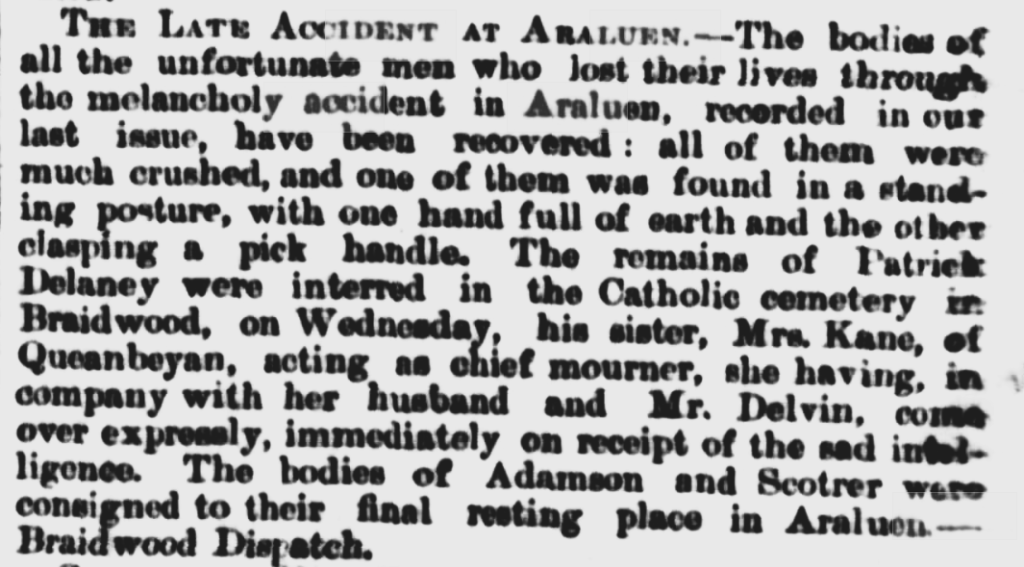
There were many mining and often fatal accidents throughout the tumultuous gold rush years. In late June 1865 the earth fell in and buried alive three men working in a drive, in a claim. In July 1865 the Empire described this fatal accident, for David Adamson and Robert Scotrer (Scorer), as did many other articles. The article then goes on to advise on the services held for the men, and ‘their final resting place in Araluen’.
TROVE (https://trove.nla.gov.au/) is an Australian online library database run by the National Library of Australia. Trove is a collaboration between the National Library of Australia and hundreds of Partner organisations around Australia, who work together to help make Australian content easier to find, share and use. It aggregates over 14 billion digital items from libraries, museums, archives, and other institutions.
