The failure of an unique and short-lived railway and of a gold mine.
© the late J.W. Shoebridge and Light Railway Research Society of Australia.
Published in April 1997 by the Light Railway Research Society of Australia, in Light Railways Newsletter No: 136, and reprinted with permission in full.
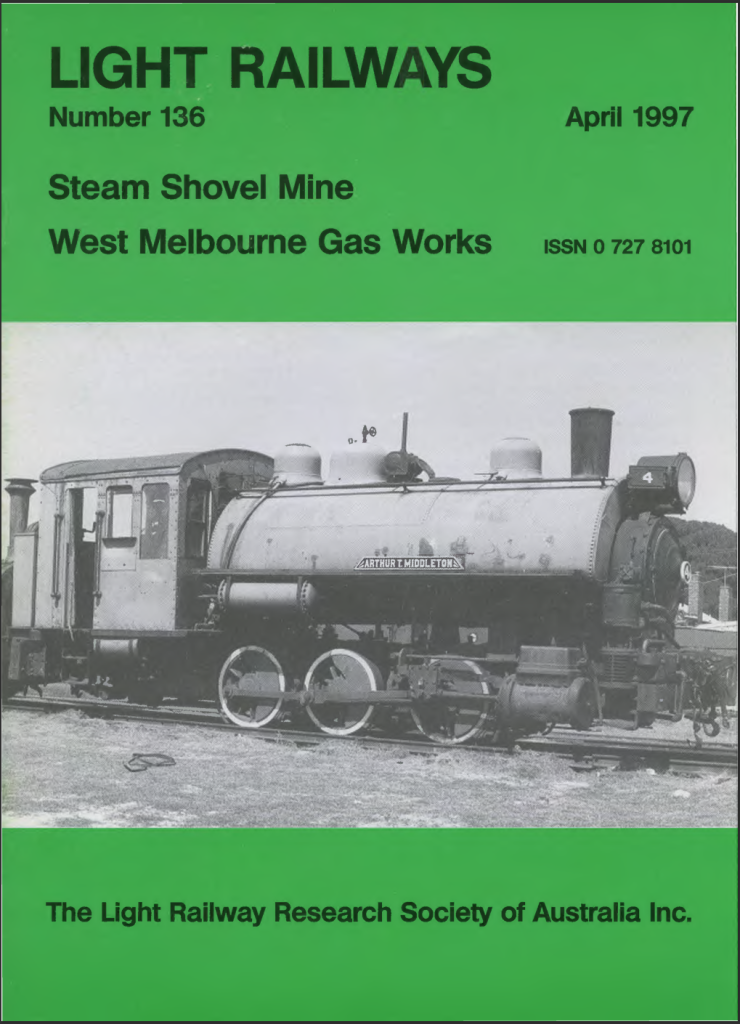
THE STEAM SHOVEL MINE, ARALUEN, NSW by J. W. Shoebridge
INTRODUCTION
This is the story of a failure, of an unique and short-lived railway and of a gold mine, which, like so many before and since, failed to live up to the hopes of its promoters. The mine was at Araluen in the mid south-east of the State, not far from Canberra. The railway was used for the transport of gold-bearing material.
THE ARALUEN GOLDFIELD
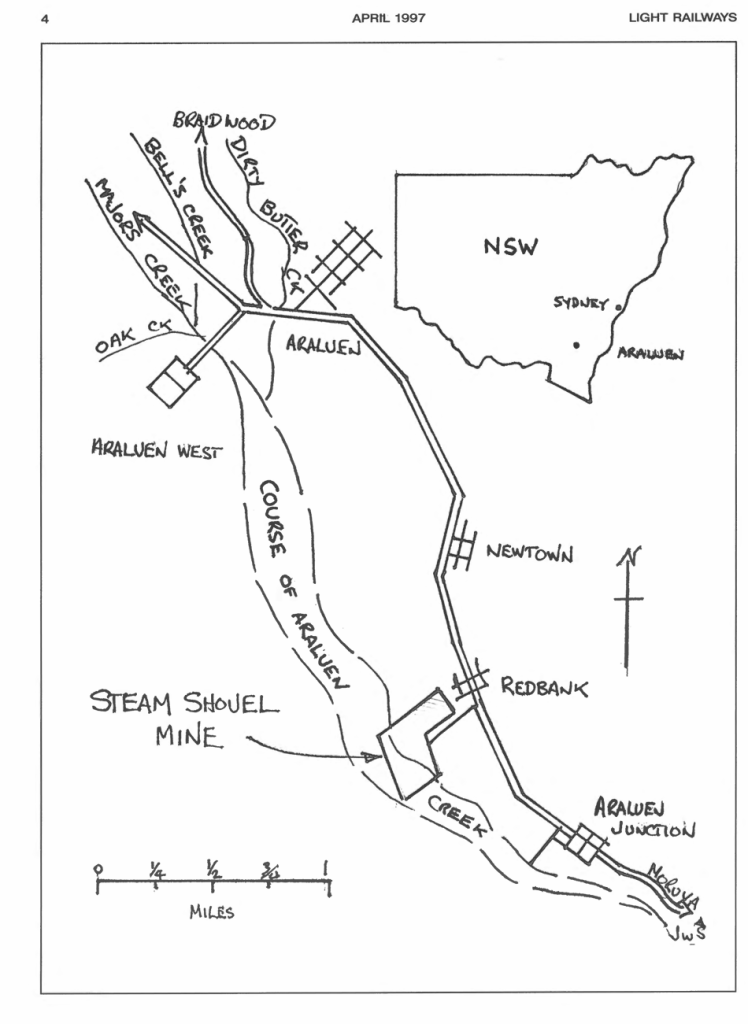
The village of Araluen is set in the pleasant valley formed by Araluen Creek close by its junction with the Deua (or Moruya) River. Araluen is 24 km by road from Braidwood, the commercial centre for the district. When mining ceased in the 1920s the population of Araluen declined, the satellite townships (North Araluen, West Araluen, Newtown and Redbank) virtually ceased to exist and after 1945 the minimal gold production was included in the Braidwood Mining Division. Gold is no longer produced at Araluen but some population has returned and the road through the valley is lined with rural small holdings and hobby farms.
The closest railway station to Araluen is Tarago, on the Goulburn to Bombala line; Tarago is 260 km from Sydney and the road to Araluen is a further 50 km with a steep winding descent to be negotiated into the valley to reach the township itself.
Payable gold was discovered in the area around 1851 and although a tent settlement sprang up on the alluvial flats along the Araluen Creek, the main population influx or ‘rush’ did not eventuate until access to the area had been improved.
Initially supplies to the district were transported by pack-horse from Moruya on the coast along the ‘Shoebridge Track’ which followed the river for 60 kms or, by a similar means along the Buckenboura track over the precipitous Clyde Mountain from the port of Broulee. A road of sorts did exist from Braidwood to Sydney via Bungonia and Marulan, but even in good seasons, teams took at least two weeks to make the journey, and in wet weather the road was virtually impassable.
Accordingly, by 1852 local agitation had commenced to gain a better means of access. A measure of success was achieved when, in October 1853, a convict gang commenced construction of 50 km of new road over the Clyde Mountain from Nelligen (on the Clyde River) to Braidwood, the work being completed by 1856.
By 1858, when the rush was at its height, it was stated that ‘there are upwards of 500 horses and as many bullocks kept continually carrying on the road between Nelligen and Braidwood and the neighbouring goldfields’.
Gold seekers and their families tramped the tracks from the coast to the area. Many stayed to work the rich reefs at Majors Creek and Jembaicumbene while others chanced their fortunes on the alluvial flats at Araluen itself or in the surrounding settlements. By 1868, the Araluen Goldfield is reported as having a total population of 200 persons.
Despite the new road to Braidwood, access to the Araluen Valley itself, still proved a problem. The road down the steep hillside was still no better than a bridle track and this required that most goods be transferred from wheeled transport to wooden sleds and lowered down by ropes along cleared slide paths.
Indeed it is recorded that the delivery of the first steam engine to Araluen required the services of over one hundred men (on restraining ropes) to negotiate the 540 metres descent.
HAND-MINING DAYS
The gold at Araluen was alluvial, from the reefs in the Majors Creek area. After the first few years when a living could be made washing dirt mined close to the surface, shallow shafts were sunk on the creek flats and timbered drives followed the courses of the buried stream beds. Initially the excavated dirt was washed close to the top of the shafts, then as the ground being worked extended away from the existing watercourse, wheelbarrow tracks and then rough roads were constructed and horse drays used to transport the washdirt to more permanent washboxes.
Difficulties soon arose with the waterlogged ground and when seepage flooded the excavations. As the field extended it was found that a large proportion of the field could not safely be worked by underground methods. Open cut methods became a viable option. Open cut workings necessitated considerable ‘dead’ work, ie the removal of overburden and excavation of drainage races. Consequently exploitation of these leases was undertaken by large syndicates.
Some of the open cuts reached 15 metres in depth and generally horse scoops were used to excavate the dirt with tip drays being used for the overburden disposal. As previously mentioned, water was always a problem, so extensive underground water races were excavated in an attempt to pre-drain the workings. Surface races were also constructed to lead water to the washboxes. On most leases, continuous pumping was the practise, utilising hand baling, California pumps (crude bucket chains), powered by horse, waterwheel or (in the larger mines) portable steam engines. Where the open cuts were close to the creek, revetted earth embankments were required to reduce the risk of creek floods overtopping the pits.
Despite these precautions, seasonal flooding played havoc with all methods of mining, whilst a dry spell meant dislocation of activities when water for the washboxes ceased to flow.
PIONEER MECHANISATION
It is against this background that the first mention of a railway on the Araluen Diggings appeared in the NSW Mines Department report for 1875. The report mentions that one of the larger claims, the Homeward Bound, ‘is worked by means of trucks travelling on a tramway laid on an inclined plane’. The same report elsewhere mentions that ‘top dirt is moved in one claim by steam engines and trucks’ with consequent reductions of mining costs.
In 1877 it was reported that Blantchford’s [Blatchford’s] Claim was using a tramway and the 1880 Report mentions ‘another party has adopted a steam engine and trucks’.
There was also at least one attempt at mechanical excavation, in 1880, when a steam winch and grab were set up on the Southern Cross Claim to strip the overburden. In the following year the Mining Warden reported that the machinery had been subject to ‘breakdowns and derangements’ and the results ‘had not answered the proprietors’ expectations’.
Also by this time the boom was over. Araluen’s peak year was reached in 1869-70 when it was the second ranked gold producer in NSW. From 1870 the field was in decline and by 1880 most of the individual miners had moved on, leaving only larger syndicate mines operating.
THE DREDGES COME
This remained the state of the gold field for some twenty years until 1899 when Messrs Tulloch & Hughton selected Araluen as a promising area to commence operations in Australia and launched a dredge. A new era of gold mining at Araluen commenced.
Tulloch & Hughton was a New Zealand firm with previous experience in operating dredges on the Otago Goldfields on the South Island. T & H claimed the Araluen dredge to be the first in NSW, hence the name of ‘Pioneer’. The dredge was apparently only a small machine, and its detractors claiming that it was poorly designed for the local conditions and it had been several times pulled under by the load of washdirt being handled!
Despite the problems the undertaking was a considerable success and before long several other parties were building pontoons, fitting machinery, excavating dredge ponds and launching their land-bound vessels on the muddy waters of Araluen Creek.
By the years 1906-09 (the period covered by this story) the peaceful valley had again become a hive of activity with the grind and clank of the following dredges:
– Araluen Central
– Araluen Central No. 2
– Araluen Proprietary,
All operated by Araluen Gold Dredging Proprietary NL and usually referred to as The Proprietary Company.
– Araluen Redbank
– Araluen Junction
– Araluen Valley
operated by Araluen Redbank Gold Dredging Co NL, The Redbank Company.
– Araluen Consolidated No. l
– Araluen Consolidated No. 2
operated by Messrs Poole Steele and Dickinson, The Consolidated Company
– Tulloch & Hughton Pioneer
– Tulloch & Hughton No. 2
operated by Messrs Tulloch & Hughton and known as The Pioneer Company.
DREDGING TECHNIQUES
The large dredges in the Araluen Valley were all of the bucket ladder type and floated in excavated dredge ponds. They normally worked to a maximum depth of 12 metres below the waterline. The steam-powered machinery was mounted on a wooden pontoon hull with an endless bucket chain (‘ladder’) suspended from a timber gallows frame. To control the depth of excavation the lower end of this bucket chain was capable of being raised or lowered by a steam winch using wire ropes and blocks.
The buckets travelled through a well in the hull into the excavation below the water line and elevated their loads of washdirt over the driving (‘tumbler’) shaft where it was deposited into a revolving trommel screen. Here jets of water were directed onto the wash and the larger stones were removed onto a stacker belt. The broken washdirt, now a slurry, flowed from the screen, over riffle tables, coir matting and finally over amalgam plates to collect (in order) the coarse, fine and residual gold. The tailings were then discharged over the launders at the stem.
Thus the dredge floated in a pond of its own making, the buckets removing the earth at one end and tailings filling it back in at the other. The increase in bulk of the excavated ground as handled by the stacker conveyers, raised tailing dumps, up to 12 metres high, of the larger material beside the dredge ponds. Although the plant advanced its own water hole along with it, in practice some creek flow was necessary to provide make-up for water losses. Water races were used to provide this make-up and the dredging plants were able to range at will virtually all over the valley floor. Boiler feedwater was piped from uncontaminated creeks and firewood was delivered by bullock teams to pond-side stacks and thence by punt to the dredges.
The actual manoeuvring of the dredges was done using wire ropes from steam winches, the winchman (the key employee on the job) being in control of the depth and the direction of the excavation.
The plants were fitted with artificial lighting, (mostly electric, though some had acetylene) and they worked around the clock for six days each week, with maintenance being carried out on Sundays.
The ‘wash up’ of gold lodged in the riffles and coir was generally done each Saturday, the results, so essential to the continued prosperity of the field, were reported on each occasion in the local papers.
The dredges were, in general, well engineered with firetube boilers, compound engines (some with surface condensers) separate lighting generators and steam winches. Each plant was under the control of its Dredgemaster who supervised an Engineman, Winchman and Boxboy on each shift.
Each company employed a manager and an engineer as well as artisan gangs with access to well equipped workshops capable of major repairs.
That the dredges were versatile machines is evidenced by the following account. On one occasion, the Elrington Dredge was forced to cross a public road to win payable ground on the far side and the local Council refused permission to mine through the area.
To avoid dismantling and re-erecting the machine and an expensive interruption to production, the stackers were used to build earth walls around the dredge pond, steam pumps raised the water level and the pontoon was floated over rails which had been laid on the surface of the ground.
The pond was drained, one earth bank shovelled away, then with multiple wire rope purchases, the steam winches skidded the whole contraption on the rails over the road to the new site, where an open-ended coffer dam had been built, the open end was closed, the interior flooded, the bucket chain dug downwards and productive work recommenced. Overall, dredging was a most economical means of shifting material, pioneering the mechanisation of materials handling.
Comparative costs mean little today, however when the engine driver was paid six shillings per week, and the Araluen dredges were handling between 50 and 70 cubic metres per shift, a dredge cost around (wages and stores) £53 per week to operate. The capital cost of setting up a dredge ready for production was said to be £10,000.
DREDGING LIMITS
Dredging had its limitations so there was considerable resistance from landowners. The operations silted downstream watercourses (the Moruya River has never recovered) and the waste material formed barren stone dumps on the once fertile river flats.
Dredge operations were limited to areas below creek level, where the gold was. The bucket chain had problems with sticky clay and with obstructions. Large boulders were either lifted with special claws or more often buried in holes dug by the buckets in the pit floor. They were dependent on sufficient water to keep the dredge ponds filled. Dry seasons often caused a complete shut down of operations.
The bucket dredges could not excavate less than 5 metres nor more than 14 metres. They also had difficulties in working irregular pockets of gold-bearing material adjacent to obstructions and, as noted above, special means had to be adopted to cross barren ground.
Gold recovery was never optimum. Space on the pontoons was limited and did not allow sufficient table size while gravity separation on a moving platform was always less than perfect.
STEAM SHOVEL SYNDICATE PROPOSALS
In October 1906 a syndicate of local mining interests formed the Araluen Steam Shovel Gold Mining Company (No Liability). The authorised capital comprised 24,000 shares of ten shillings each and the promoters were allocated1,200 fully paid-up shares in return for certain property rights.
The company offices were in Vickery Chambers, Sydney and the directors were Mr James Lawson (chairman), who was associated with the Proprietary and Redbank Companies, Austin Chapman, the local federal member of parliament (and Minister of Customs) and W.V. [U] Alley who was a local storekeeper and mining speculator. The secretary was S. Kearney and T. Nelmes Bluck was appointed as consulting engineer.
At that time, Bluck was the manager of the Proprietary Company. He had come from New Zealand with Tulloch & Hughton. He was said to be well liked in Araluen and considered to be a competent mining engineer.
The syndicate’s proposal was that a steam ‘navvy’ or mechanical shovel be operated in an open cut, firstly to strip the barren top cover with rail trucks used to take this overburden to a dump. The shovel would then excavate the gold bearing strata and the railway would haul this washdirt to fixed washboxes adjacent to the creek.
It was in essence a mechanised version of the original open cuts of the gold rush days. The promoters’ prospectus asserted that the cost would be one third of that of old methods (manual excavation) and that thirty men would be employed when the mine was in full production.
This optimism is difficult to understand, in hindsight, as the dredges provided the most efficient means of shifting dirt then available. Labour requirements would be greater than the dredges and there would appear little advantage in transferring the excavating machinery from a pontoon to rail tracks. The use of fixed washboxes had some advantages but the prospectus made no mention of this.
PROPERTY ACQUISITION
The company acquired an initial area of land at the upper end of Redbank. This land comprised 20 hectares purchased from the Redbank Company, whose dredge was said to be obtaining good values nearby, and four ha from Messrs Duggan and Sons who had worked an open cut eleven years previously with alleged good results. They surely would have been more than pleased to sell worked ground! The Duggans (shrewd fellows) were paid £800 cash and 200 script.
The location of these properties was at end of the laneway behind Alley’s Store and 200 metres west of the Araluen to Braidwood Road. Whatever the reasons for again adopting open cut working, albeit mechanised, it is difficult to see how the previous working of the ground was so lightly discounted. Of course it may be that the syndicate was forced to purchase this ground to gain suitable water rights for their sluice boxes in any case the initial excavation was planned to commence on this previously mined ground.
MACHINERY PURCHASES
The company proceeded with its arrangements and after approaching a number of machinery agents in search of a suitable excavating machine, early in 1907, placed an order with Messrs Gibson Battle for a Ruston Proctor 10 hp steam shovel.
This machine was said by the agents to be the same as those recently employed digging the Manchester Ship Canal (completed 1894) and they quoted a delivery time of four to five months, landed in Sydney.
All shares had by this time been taken up, an engineer (name unknown) was engaged, and a gang of labourers commenced to clear a site for the erection of the machinery. By the end of January, ten tonnes of plant had been delivered and a further 40 tonnes was on the road from Moruya, a wooden office and a galvanised iron locomotive shed had been erected, the main washpump sump had been excavated in the creek together with a tailrace for the return water.
The railway tracklaying had been commenced with 100 metres of line in place and an advertisement in the local paper sought tenders for the supply of firewood and broad and standard gauge railway sleepers. Similarly, the Sydney papers had invited tenders for the supply of rolling stock and a contract was let with a Sydney firm (unnamed) for the manufacture and delivery of railway dump trucks.
About this time a locomotive was apparently purchased (whether directly from the original owners, NSW Government Tramways or through a dealer is not known) and it was sent by rail from Sydney to Tarago.
STEAM SHOVEL ERECTED
Early in the year, the Gibson Battle foreman and his erecting gang arrived in Araluen and the assembly of the shovel commenced. The components were regularly delivered by the Moruya teams and the job progressed without delay. At the same time five teams were on the road from Tarago with the railway trucks and these were all on site by the end of the same month.
The locomotive was also hauled from Tarago by Hugh O’Reilly’s horse team, although the specific date of its arrival was not recorded.
The loco was reassembled and tested under steam on 20 April. One week later the navvy was also complete and under steam, well ahead of schedule, and its acceptance trials, in soft ground (!), were held by Gibson Battle on 27 and 28 April and witnessed by the Directors.
The steam pumping plant had been purchased second hand from mines in Tasmania and Victoria. It had also been erected and tested and the directors and their consulting engineer expressed complete satisfaction with all arrangements.
DESCRIPTION OF THE PLANT
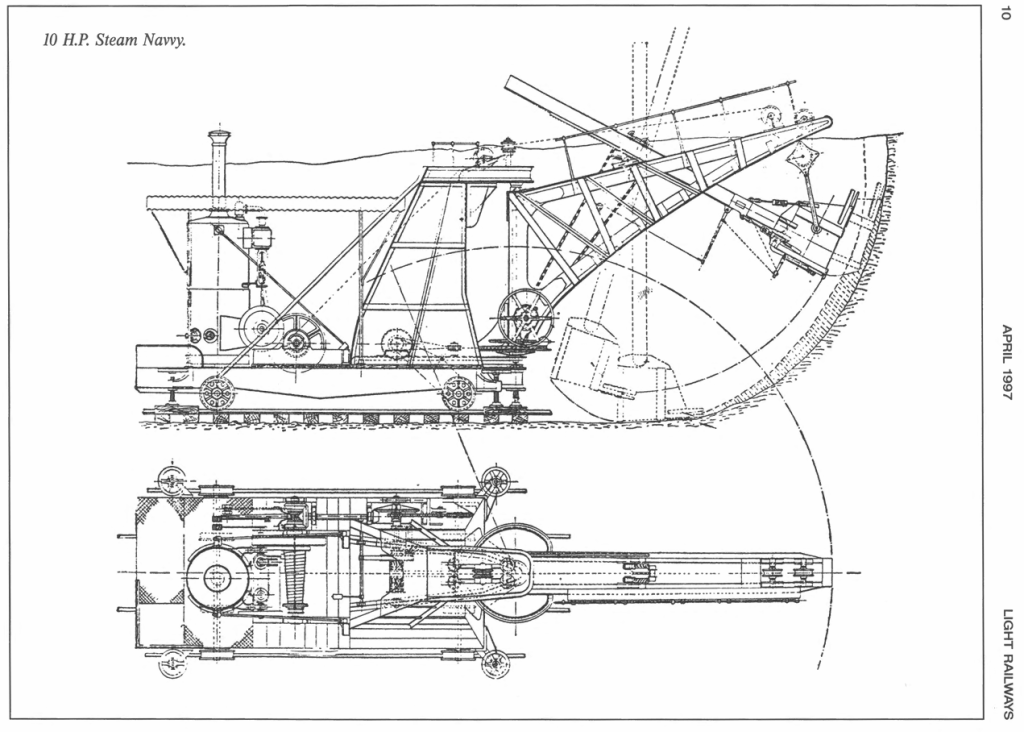
The steam shovel ran on four wheels on a broad gauge rail track, with the wheels fitted with extra wide treads. Steam was generated in a vertical boiler and the machinery was enclosed in an iron sheeted cab.
The bucket had a capacity of 2.25 cubic metres and could dig 2.2 metres below rail level. The machine body or ‘travelling framing’ was fitted with screw jacks at one end and whilst in operation, timber planks (14 x 2 in) were packed underneath to increase the machine’s stability. It is not clear from the description if the 360 degree swing was available.
An illustration captioned ’10 ton Steam Navvy’ appears in the ‘Encyclopaedia of Practical Engineering’ and is accompanied by the following text:
“One of the best known excavators is the Ruston. The crane is built specifically stiff and steel enters largely into its construction. Except that it is has a vertical cross tube boiler and double cylinder engines it bears little resemblance to the ordinary cranes.
The place of the post and side frames is taken by the plated tower, well braced. The jib is as deep as the tower where the two are attached and is of the double webbed lattice braced type. The main hoisting drum which lifts the bucket is of fusee form. Another drum driven through a third-motion shaft slews the jib.
The bucket is of steel and having picks or tines at the front edge for penetrating the soil. These are made of different patterns to suit different soils and some have detachable shoes of manganese steel. The bucket is attached to a handle of oak (or metal) strengthened with iron plates which swings between the jib sides. Its depth of cut can be regulated by a rack and pinion connected by a pitch chain to a handwheel controlled by an attendant located on the platform at the foot of the jib. It is provided with a foot brake.
The bucket is provided with a door for the discharge of the contents, which is self closing but is opened by the attendant pulling a cord.
The machine is worked by lowering the bucket until its handle is in the vertical position with the crane brought to the face of the cutting. The engine being then started, the bucket is dragged forward and upward into the earth. The depth of the cut is regulated by the quantity of material required to fill it by the time it has reached its top position.
The jib is then slewed to hang the bucket over the wagon brought up in readiness and its contents are discharged by releasing the catch of the door. On slewing the jig back to the next cut and lowering, the door closes automatically.
The best economics are obtained when double track roads for wagons flank a central gullet, first cut by the navvy for its own passage. Working thus as much as 378 wagons of moderately stiff soil each holding 4Y2 cubic yards have been filled in ten hours. An average of 300 to 350 wagons should be obtained. With one track or side road the output is somewhat less. Generally the rapid handling of wagons is of importance since the excavator will make from 80 to 120 cuts per hour.“
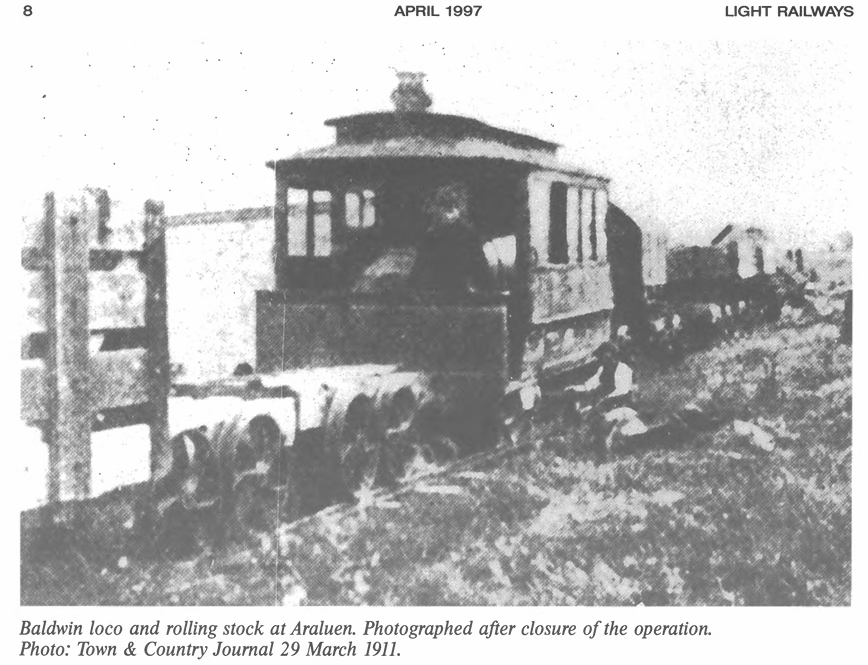
The locomotive was second hand and the writer has found no record of how it was purchased. It was a standard nine by fourteen inch cylindered Baldwin steam tram motor from the NSW Government Tramways although there remains some uncertainty regarding its specific identity. This size of motor, weighing around 14 tons, had recently been made redundant in the tramway service following the electrification of Sydney’s George Street lines.
The little engine retained its overall wooden cab but a raised wooden headstock and dumb buffers were fitted and it is assumed that the couplings were suitably modified. In tramway service these motors were fitted with Eames vacuum brakes.
The dump trucks had timber frames and were similar to the type used for railway construction work; they could be tipped to either side or over one end. Sixteen were purchased. Two or three trucks never had bodies fitted and were used to carry rails and timbers.
The fixed plant comprised a Marshall 16 hp portable engine belted to a Robinson eight inch centrifugal pump on a timber bed with the whole arrangement housed in a galvanised iron shed. Also driven from the same portable engine was a 28 inch circular saw for firewood and a 4 inch pump to drain the excavation.
EXCAVATION COMMENCES
Following the plant trials, work commenced forthwith to excavate the open cut. The navvy dug deep into the soft ground and the little locomotive easily hauled its train of five trucks over the initially level track to be tipped as an embankment leading to an overburden dump adjacent to Old Duggan’s Dump.
In the first week or so a great deal of interest was taken in the project by the local mining fraternity and the small train was a source of great joy to the local children.
Mr Parsons, the local manager of the Consolidated Company, was a regular visitor and shortly he took up land adjacent to the Steam Shovel Mine on behalf of his firm with the view to a similar cut should this venture prove a success.
Around this time a local racehorse ran at various meetings around the district with limited success under the inspiring name of ‘Ryans Steam Shovel’!
The directors held a meeting on 9 May 1907 and stated that they were pleased with the operations so far. Mr Bluck, the Consulting Engineer (and now the Acting Manager), reported that the navvy had now been tested ‘in very stiff ground’, that costs had been below estimates and that the time schedule had been adhered to.
So far so good.
The excavation into the cut was now well under way. At this location, the overburden was thought to be about five metres thick, so the plan was to strip the barren ground in two 2.5 metre benches. The wash beneath was expected to be between 1.8 and 2.5 metres thick and this would form the third bench with the rail tracks laid on the pit floor, thought to be decomposed granite. Further into the property it was ‘hoped’ that the wash would increase in thickness to six metres and then it would be worked in two benches. There is no evidence how these estimates of thickness were arrived at. The grade of the line into the cut was set out at 1 in 30 and this grade was maintained up the embankment to the top of the dump. The working face was to be 55 metres wide. It is not clear if the navvy rails were parallel to the face or if there were several lines at right angles.
Work continued around the clock into the month of June by which time the embankment had reached the location for the junction of the line to the ‘Tip Head’ where the sluice boxes would be located.
When the pointwork to the tip head line was laid, it was discovered that the locomotive could not negotiate the turn and the Consulting Engineer reported to the board that the points ‘had not been supplied as ordered’. As the dump trucks seemed to have no problems on these points, perhaps the little matter of the tramway contour wheels had been overlooked (NSW Tramway vehicle wheels had smaller flanges and greater back-to-back measurements compared with railway wheels).
After a week of fruitless experiment when the locomotive was more often off the rails than on, operations were suspended, the workmen were discharged and a new set of engine wheels (or perhaps only a set of tyres) was obtained in Sydney and rushed from Tarago Station by Hugh O’Reilly. It can be assumed that these were purchased from the NSW Government Tramways whose Kogarah line was built to railway standards so that wheel sets for the motors from this system would have been readily available at Randwick Workshops. The locomotive was raised on sheerlegs for the wheels to be fitted. After the two week shut down the mine resumed stripping operations and no more was said by Mr Bluck regarding defective points.
By now the navvy was said to be cutting well down the slope. With only one track in use, delays were experienced while the rake of trucks was placed for filling. In early July the embankment subsided and the train was derailed with the engine being off the line for two days. Whilst one gang of men laboured around the clock jacking the engine back onto the line and repacking the track, all spare hands were at work laying a second track down the slope so two lines could serve the navvy. Thus one rake of trucks could be filled whilst the other was being hauled to or from the tip.
The tiphead was next completed and the sluice boxes (of semi-circular iron) were being installed when the navvy reached the floor of the cut. It was now found that the Duggan’s Open Cut had worked this area and thus the barren ground was extended further than anticipated. (Shrewd fellows those Duggans!). In those days no operator would fill in an excavation except as a convenient means of disposing of material dug to make another hole. So there arises a suspicion that perhaps the Duggans had backfilled an even earlier open cut which they conveniently forgot when they sold the property to the syndicate.
Mr Bluck advised the board that no productive work was in sight until at least the end of August in fact, although he did not say so to the board, he complained to the local press that the ‘dead work’ was twice that which had been allocated for.
As soon as the operators were below the floor of the original cut, (ie the top of the washdirt) the water table was reached and seepage began to rise through the unconsolidated fill. The ‘old hands’ could have told them this would happen. Work pressed on but the pump at the portable engine site proved incapable of draining the working face. One suspects the suction line was too long. An independent steam pump was set to work in the cut itself, perhaps fed from the navvy boiler.
This pump proved to be too small and in any case was soon clogged with the silt stirred up by the action of the navvy bucket. The water continued to rise and eventually work had to be suspended for two days until a Pulsometer pump was obtained. This steam hungry beast dealt with the clay and silt but required its own 20 hp boiler and fireman.
It was now almost the end of August, payable ground was nowhere in sight, the basement floor (under the washdirt) was found to be softer than expected and the navvy’s rail tracks subsided under the weight of the machine. Additional sleepers provided a solution but it was a warning of problems to come.
The rain came and brought with it a ‘fresh’ in the creek, boiler feed water was contaminated and a race had to be excavated for about 1.5 km to Dirty Butter Creek where clean water was to be had. The pump at the portable engine was now used to raise this water into an elevated tank. A pipe from the tank then fed water to the navvy and the pulsometer boiler down in the cut. The locomotive took water direct from the tank.
GOLD AND SHUTDOWN
Finally on 17 September, the long awaited day arrived, the barren ground had been crossed and the first wash dirt had been reached, the washpump was run, the sluice boxes adjusted and production commenced. But now the washdirt was found to have a considerable (unexpected ?) clayshale component, and the slippery conditions proved too much for the locomotive and it could not pull the required number of trucks up the incline. On 25 September, after a week’s half-hearted struggle, the mine ceased work and all employees were discharged.
RESPITE
Although the figures of the gold values obtained were not released to the press, it is apparent that the major cause for closing the mine was not the haulage problems but the disappointing washup results exacerbated by the dissipation of working capital in the excessive dead work and wet conditions.
The local papers claimed that £7,000 had been spent to obtain 25 dwt of gold and, as ever, they attributed this to ‘bad management’ and stated that the haulage problems were due to the use of 40 pound per yard rails. In fact a manager, name unrecorded, had been appointed at the beginning of September. He came on the scene too late to influence the course of events and just in time to take the blame and he was discharged when the plant was laid up.
The board held an extraordinary meeting to consider its future, and although all was not well with the Araluen dredging industry, it decided that further funds should be raised and additional plant purchased.
Additional checks were made on the wash. These results must have been more encouraging because the board’s decision was confirmed at a meeting on 21 October. It was then decided to ask the Shareholders for approval to increase the capital of the Company by £2,400 with an issue of 4,800 preference shares. A further meeting was held on 11 November. At this meeting Mr Bluck (who had retained the backing of the board) reported with ‘confidence’ and outlined his plans for future work. Primarily he recommended that the syndicate install a fixed haulage engine with wire ropes to haul the trucks from the cut, thus reverting to the proven technology of 1875.
DIVERSIONS
The same Mr Bluck was at the time a very busy man. On 2 October the Araluen Central Dredge sprung a plank and sank in the middle of nightshift. The crew amidst confusion paddled ashore in the firewood punt!
Next week the fireman on the Central No 2 Dredge burnt the boiler crownsheet and an explosion was only narrowly averted. On the Redbank Dredge the main engine cylinder block cracked and had to be removed and repaired.
Fitters and blacksmiths toiled around the clock to complete the mechanical repairs while the remainder of the workmen were put to manually digging a diversion channel to drain the No 1 dredge pond. The Navvy Pulsometer and its boiler were borrowed and moved from the Navvy cut to assist with the salvage. In the course of this work the excavation gang unearthed a portable steam engine, buried after the last rush.
AT THE NAVVY
It was some time before Mr Bluck was able to devote his attention to the needs of the Steam Shovel mine. It is not until the meeting on 14 April, 1908 that he reported to the board that the plant had been overhauled and would be restarting in three weeks. It was expected to be on wash in June.
The additional capital had been raised without undue trouble although there were misgivings mooted in the local press. The Company’s ordinary shares were selling at two shillings with preference shares still at par. Mr Alley had resigned from the board consequent with his leaving the district and it is understood that he set up in business near Sutherland, South of Sydney. He was replaced by a Mr Nicholson.
As stated by Mr Bluck it had been hoped to start work in May and on his recommendation Mr A Neil was appointed as Manager. When the three dredges recommenced work after their salvage and repairs there was a shortage of firewood. The contract firewood cutters who had been left without trade while the dredges were idle had departed to seek work elsewhere. Newspaper reports state that most were employed on the new railway works from Goondah to Barren Jack Mountain.
Poole and Steele had decided against using a steam shovel on their adjacent lease and had launched their steel-hulled ‘Drednought’ dredge. This was the largest plant in the field and designed to work deeper than 13 metres.
Mr Lang, their engineer, had purchased two traction engines, a Marshall and a Clayton & Shuttleworth and they hauled firewood from beyond the valley. Other operators re-instated the slides down the hillside and loads of timber were sent down these to splintered destruction although still useable as fuel and eventually the firewood situation was restored.
NEW MANAGER, NEW START
The Steam Shovel Mine (as it was known locally) restarted on 15 June 1908 with the new manager, Mr Neil, introducing some changes. A new driver, Mr G. Gordon, was engaged to take charge of the locomotive; the original navvy driver, Mick Duggan, was retained and William Wallace was placed in charge of the portable engine at the washboxes. No mention is made of the drivers on the backshifts.
While the mine was shut down much of the rail track had been relaid and when operations recommenced the rakes were reduced to four trucks. This time the locomotive had no difficulty in hauling the trains from the pit and the proposal for a fixed haulage was forgotten. Mr Neil had also modified the trucks so they were self tipping thus dispensing with the need for four tip-head men.
The mine was in full production employing 25 men on three shifts when, at the end of August, the washdirt thinned to one foot due to a ‘geological disturbance’. At the same time the pavement became uneven and required hand grading to allow the navvy tracks to be advanced.
At this time it is reported that the navvy track was laid up the centre of the face with a standard gauge line each side, the dump trucks being placed either side of the shovel to be filled. The locomotive hauled its train up the incline, then reversed and propelled the trucks to the tip head.
Despite the expensive hand grading the navvy now found difficulty in loading uncontaminated washdirt on the uneven floor. If clay was mixed with washdirt then problems arose at the washboxes so five men were employed on day shift to hand-load the depleted washdirt. The navvy was moved up to the first bench and pushed ahead on overburden removal in order to pass onto more profitable ground as soon as possible.
Additional leases had previously been applied for in 1906 but with objections lodged by both the Redbank Company and Mines Department considerable delay and litigation had ensued. Eventually the Steam Shovel Company was successful. The leases were granted in 1908 and these new unworked areas were the focus of the syndicate’s hopes.
HARD GOING
In August, the weekly gold washup averaged 15 oz, whereas the dredgers were averaged 18-20 oz each and the mine now required 30 men, against 12 on a dredge, so the outlook was not encouraging. Notwithstanding, an extra five man gang was started to hand load washdirt on afternoon shift while the navvy was moved to excavate overburden in the new paddock. Even though all the washdirt was now hand loaded, clay was finding its way into the wash plant and gold was carried over with the tailings so that additional washboxes had to be installed.
The first washup in September showed some improvement. The syndicate claimed that hand loading gangs were a success, even though the local newspaper claimed that the cost of hand filling was ten times the cost of dirt loaded by the steam shovel!
Then the rains set in and the pit floor became a quagmire. Work persisted through that wet September. The hand loading was wild, heart breaking work especially on the night shift. Kerosene pressure lamps provided the illumination. Two men loosened the wash with mud picks then three others followed along the bench, in mud over their boots, throwing the sodden wash with long handled shovels over the sides of the dump trucks.
Though soaked with the rain on wet nights the men were at least protected from the bitter wind down in the cut. Even in ‘them ‘ard times’ extra wages were necessary to attract men to this type of work and the local paper reported that the men at the Steam Shovel Mine were the best paid labourers in the Valley.
By the end of September the wash was again two metres thick and no more was heard of the predicted four metre thick paydirt. But even in the new lease areas, the pit floor had further deteriorated into uneven sticky clay. More clay found its way to the washboxes so more washboxes were added and this in turn necessitated a new tailrace to bypass the small mountain of tailings which had accumulated.
Despite all efforts, gold was still being lost and the washup results for the end of the month, though not disclosed, were said to be ‘particularly poor’. Then the shovel moved onto the soft ground on the pit floor to load the washdirt but its rails subsided. The hand loading gangs had to be taken off productive work to grade and ballast the floor for the navvy trucks. Extra jacks were added to the frame, and despite its wide wheel treads, the machine was several times derailed whilst tramming forward.
More and longer sleepers were used and the bent rails were replaced after every move. Still the track sank in the mud. More sleepers were packed under the track until in places the line rested on three layers of broad gauge sleepers. Finally a rail broke and the machine sank into the ooze up to the level of the frame.
The hand loading gangs maintained production whilst all other employees worked around the clock in the mud for two days and nights to jack and pack the navvy back onto its rails. Production resumed but this could not go on much longer.
FINAL CLOSURE AND DISPOSAL OF PLANT
Following a washup of only 9 oz for a week’s work, instructions were received from the Sydney office to shut the mine and discharge the men.
The last day of production was 14 October 1908, although Mr Neil and eight men were kept on for a short time to move the navvy from the pit and recover the rails. This was soon accomplished, the salvaged material was stacked, machinery was greased, the locomotive run into its shed and the fires were dropped for the last time. The men and the manager went their ways and all was quiet by Christmas.
On 23 January 1909 the directors held their final meeting and resolved that the remaining debts should be discharged, the assets liquidated and the company wound up. The company secretary was appointed as liquidator and the company’s solicitors were instructed to have the following advertisement placed in appropriate papers:
“SALE BY AUCTION
BY ORDER OF THE LIQUIDATOR
ARALUEN STEAM SHOVEL GOLD MINING
COMPANY NL
Property consisting of two gold dredging leases containing resp. 39 ac. and 10 ac. 3r. 30 p. situate on the Araluen Creek together with all machinery on the mine consisting: Ruston Proctor 10 hp, Portable Steam Navvy with 1 Y, cu. yd bucket, 16 hp Marshall Portable engine double cylinder, 20 hp Boiler Saddle Tank Main Locomotive with tip wagons and rails, pulsometer, tools, stores and sundries.
To be auctioned by J.E. Green and Co. 110 Pitt Street, Sydney at 11.30 am 11/2/09″
The sale was held as planned but only the portable engine and pumps were sold, the navvy was passed in and there were no offers for the little locomotive.
The Araluen Consolidated Company soon acquired the leases and in June 1909 it moved its steel-hulled “Drednought” [Dreadnought] dredge to work the ground. The gaunt old navvy stood rusting alongside the flooded pit with its cab sheeting clanging in the wind while the locomotive slowly corroded in its shed.
The Consolidated Company engineer was asked to undertake the role of caretaker and in return he was permitted to remove any useful tools and stores from the workshop and the sad story was nearly at an end. In 1909 Mr Bluck, the ‘popular and brainy Mr Bluck’, resigned to take up a position in Siam with the Tonkah Harbour Dredging Company. He left Araluen with the good wishes of the populace on a world tour to inspect the latest developments in electrical dredges prior to taking up his post. He left behind the motor tricycle on which he travelled through the valley and as far afield as Moruya, for many years it was stored in a farm shed. It may be there yet.
In November 1908 Mr McDowell, the new manager of the Consolidated Co. dredges, was advised by Poole and Steele that they had purchased the steam navvy and instructed to send his fitters to dismantle the machine. It was then hauled by horse team back to Moruya whence it had come and shipped to Poole and Steele in Balmain.
There is no record of its eventual disposal.
Over the next few years several prospective buyers were shown the railway plant, among these was an engineer representing the Takapuna Tramways & Ferry Co Ltd who operated a 4′ SY,” gauge tramway on the north side of Auckland harbour, New Zealand. The engineer did not like what he saw and purchased nothing. Over time the engine shed fell away and the locomotive stood in the open along with the rotting dump trucks.
The only photograph which has come to light was taken in these years and appeared as part of a series of stereoscopic views in the Sydney Mail newspaper. Finally, in 1914, the locomotive was sold to the machinery broker Mr J OToole who no doubt engaged the good O’Reilly to haul it up the hill and out of the Valley to Tarago. There it was reloaded into a railway truck and despatched to Dapto where it was used to haul coal trucks on the South Kembla Colliery railway.
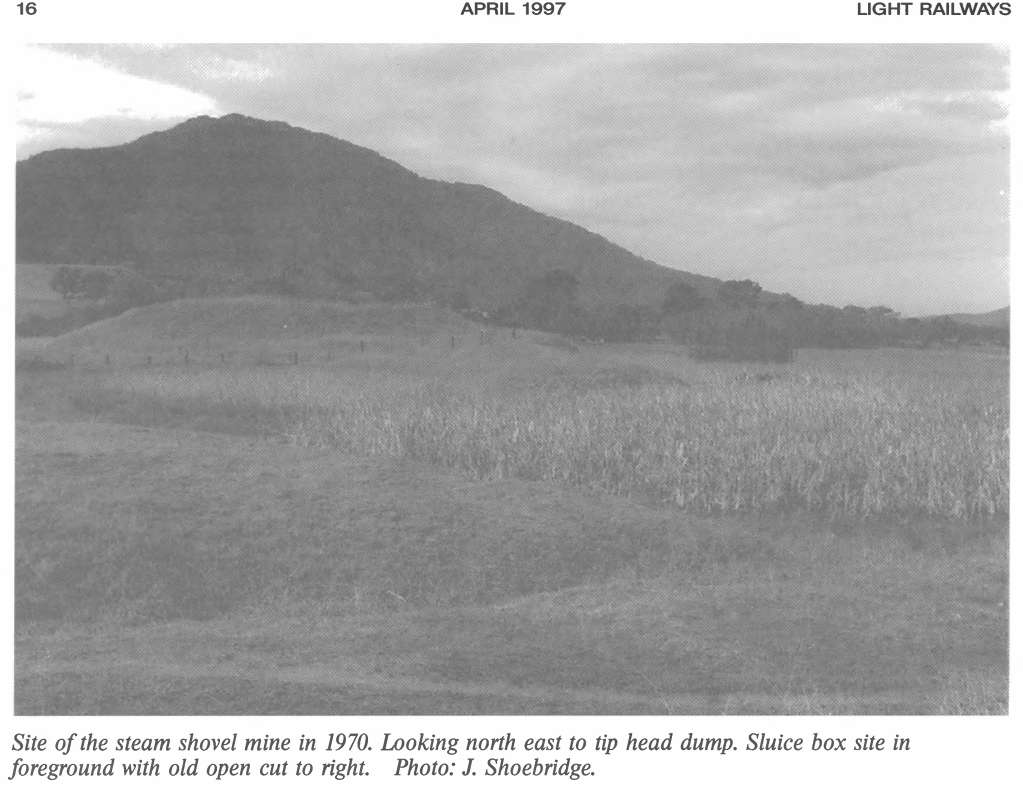
The trucks and rails had by then long gone. The site of the Steam Shovel Mine was worked over by the Consolidated Co. dredge which filled in the pit and levelled the embankment and most the tailings dumps. Dredging continued until 1927 when the Mines Department report of that year noted that the last two plants, the Araluen Redbank and the Araluen Valley, had ceased operations.
From time to time, as gold prices fluctuated, some smaller operators reappeared so that it was not until November 1955 that the final obituary of the goldfield appeared in the Commonwealth Engineer Journal:
“FOR SALE GOLD DREDGE
Breaking up at Araluen NSW
Timber Pontoon and Superstructure – Buckets 5 cub ft – Mooring Winches – Massive Spur Gears – Lifting Gear and Steel Cables – Blocks – Steel Etc
William F Wilson & Son Engineers – contractors – Araluen NSW”
(This would probably have been the Glen Innes Syndicate’s plant, said to have been idle for some years.)
For Araluen … The Rush had finally ended …
Today in Araluen Valley there is little evidence of the mining operations, after the dredges had gone, nature and agriculture soon reclaimed the ravaged landscape and today the Valley is a hobby farm haven for the public servants from Canberra who would never dream of the frantic activity of bygone years.
Yet (as late as 1977) when I asked one elderly resident for the location of ‘The Navvy’ she unhesitatingly directed me to the empty paddock at the end of Alley’s Lane!
REFERENCES
Australian Mining Standard (1905-1914)
Braidwood Express
Braidwood Despatch
Dredging for Gold (JSW McGeorge 1964)
Encyclopedia of Practical Engineering (Horner)
Gold Dredging (CC Longridge (1905))
NSW Town and Country Journal (1905-1914)
NSW Mines Department Reports (1875-1955)
ACKNOWLEDGEMENTS
Grateful acknowledgement is made to:
Messrs Bruce Macdonald and Norm Houghton for information and assistance.
Tom Costello and Hec Fraser (both now deceased) who in their youth worked in the mines and on the dredges at Araluen and who told me how it really was. And to the late Ken McCarthy who assisted me with both tramway information and field investigations.
Author – J. W. Shoebridge. © the late J.W. Shoebridge and Light Railway Research Society of Australia.